rouf

Abdur Rouf

My current research spans reinforcement learning–driven optimization and large-scale distributed experimentation for next-generation networked systems. I focus on intelligent flow management in Software-Defined Networking (SDN), efficient state encoding for Deep Q-Network (DQN)–based decision systems, and speculative transport protocols capable of predicting future traffic patterns. 
Current Researches:

RL-Based Flow Placement and Flow Aging in SDN

This project develops a Deep Q-Network–based flow placement and eviction mechanism for SDN switches. By combining RL and adaptive flow aging policies, the system intelligently decides which flows to insert or evict, significantly reducing miss rates compared to conventional reactive flow-management algorithms. I am currently investigating optimal hyperparameter and system configurations to help network engineers easily adopt this framework in production environments.
Reference papers: [IEEE ICMLCN ’24]

Bloom-Filter–Based Encoding for DQN in SDN Applications

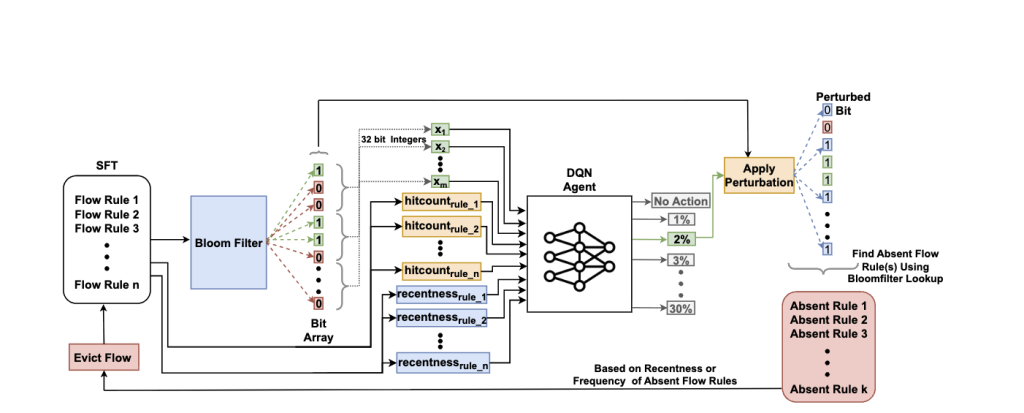
In this work, we design an efficient encoding and decoding mechanism for DQN agents used in SDN environments. Our bloom-filter-based encoding keeps the output dimensionality constant while preserving spatial relationships among flow rules. This allows DQN models to scale to large rule sets and improves decision accuracy. Applied to a flow-eviction application, this approach demonstrated a noticeable improvement in hit rate and overall performance.
Reference papers: [IEEE NFV SDN 2025]

Speculative Transport Using Reinforcement Learning

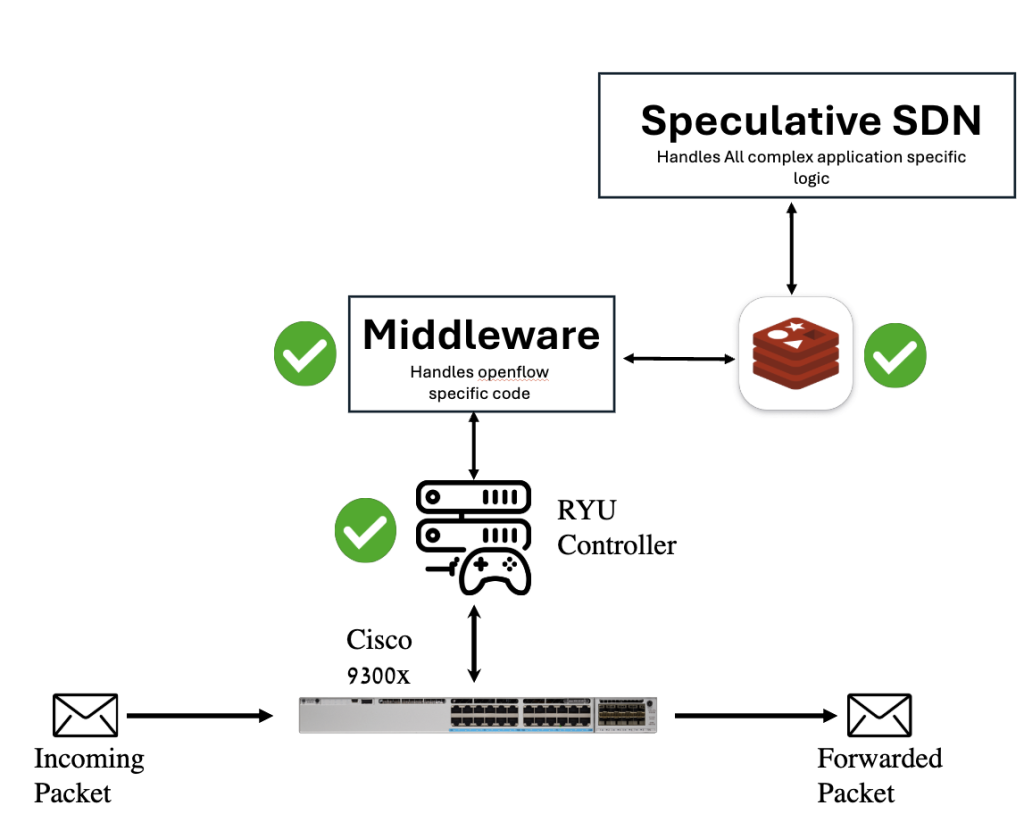
This ongoing project explores how reinforcement learning can be used to design speculative transport protocols. The goal is to predict future bytes or packet sequences before they arrive, enabling ultra-fast, low-latency communication. By modeling traffic behavior and learning predictive patterns, this system aims to augment or replace traditional TCP-style reactive transport mechanisms.
Reference papers: [N/A]

Distributed Job Execution Framework for Large-Scale Experiments

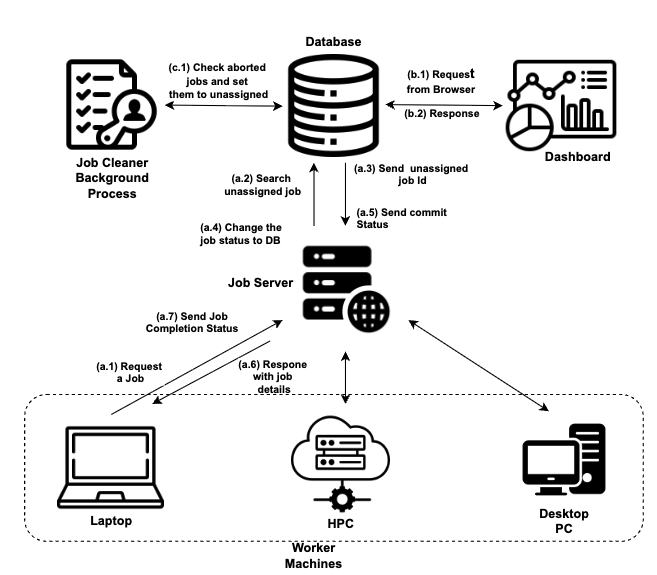
Many of these RL-driven SDN and transport projects require massive computational resources, often running for millions of CPU hours. To support this need, I am building a job distribution and orchestration framework capable of deploying workloads across HPC clusters, HTC systems, and cloud environments. This platform automates scheduling, resource allocation, and monitoring, enabling efficient execution of large-scale network research experiments.
Reference papers: [N/A]